The 7 Pillars of Mindfulness and Why They Matter When You’re Chronically Ill
Mindfulness gets a lot of airtime. Breathe deeply. Stay present. Let go. But when you’re managing a chronic or complex illness and navigating appointments, symptoms, uncertainty, and a healthcare system that can feel overwhelming – generic mindfulness advice can fall flat fast.
Before I began my journey with chronic and complex health diagnoses, I was trying to figure out why I was so frustrated by the medical system and why I didn’t feel in control – of myself, my health, or my reactions.
What actually helps is understanding what mindfulness really is. Not a technique you practice for ten minutes before bed, but a way of relating to your life, your body, and your circumstances that can shift how you experience everything, including your health journey.
At the heart of mindfulness are seven foundational qualities, originally described by mindfulness pioneer Jon Kabat-Zinn. Together, they offer a practical and compassionate framework for anyone learning to live well with a health condition that doesn’t follow a simple or predictable path. 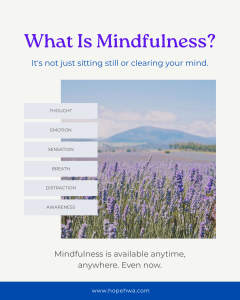
What Is Mindfulness, Really?
Mindfulness is the practice of paying deliberate, non-judgmental attention to the present moment. Rather than trying to fix or escape what’s happening, mindfulness invites you to meet your experience, be it physical, emotional, or mental – with curiosity and openness.
For people living with chronic illness, this matters enormously. When your body is unpredictable, when symptoms shift, when medical answers are slow to come, the instinct is often to push harder, worry more, or brace against the next difficulty. Mindfulness offers a different path: steady attention, honest acknowledgment, and a gentler relationship with what you cannot fully control.
The 7 Pillars of Mindfulness
1. Non-Judging: Notice Without Labeling
The mind is a tireless evaluator. Good, bad, right, wrong, should, shouldn’t – these judgments run almost constantly in the background.
Non-judging doesn’t mean ignoring what’s difficult or pretending things are fine. It means creating enough space to see what’s actually here, without immediately layering a verdict on top of it.
Try this: The next time you catch yourself thinking, “I shouldn’t feel this way,” – PAUSE.
Replace it with: “This is what I’m feeling right now.” Notice the difference between experiencing something and judging yourself for experiencing it.
Living with chronic illness often comes with invisible weight, guilt over cancelled plans, frustration at your body, shame around needing more rest than others. A skilled health and wellness coach can help you begin to notice those patterns and gently loosen the grip judgment has on your day-to-day experience.
2. Patience: Allow Things to Unfold in Their Own Time
When life feels uncertain, the pull toward resolution is powerful. You want answers, progress, relief – now. Patience isn’t giving up. It’s recognizing that some things have their own timeline, and that constantly pushing against that reality creates its own kind of suffering.
This is a particularly difficult pillar for my chronic illness friends, as it sounds a lot like saying that you should just wait for something to change and hope for improvement. The idea of patience in the conversation around mindfulness has a lot of nuance to it, and working with someone like a wellness coach can help to take your personal lived experiences to bring more life to this pillar.
Try this: When you notice the thought, “I should be further along by now,” take one breath, PAUSE, notice where you feel the tension, and then ask: “What does this moment need from me—not what do I wish it were?” Then take the next step, rather than trying to solve everything at once.
For people managing complex health conditions, patience is often the hardest pillar to practice, especially when you’re advocating for your own care. Having support from a patient advocate can make this easier. When someone is helping you track your history, prepare for appointments, and ask the right questions, you can stop white-knuckling every outcome and start trusting the process a little more.
3. Beginner’s Mind: Meet This Moment With Fresh Eyes
We approach most situations through the filter of what we already know, expect, or fear will happen. Beginner’s mind invites curiosity instead. Even when you’ve been through something many times before, this moment may not be exactly the same as the last.
Particularly when you’ve seen the same doctor before, or you have had negative experiences with the office staff, or the doctor has been dismissive in the past.
Try this: The next time you think, “I already know how this is going to go,” PAUSE and ask: “What if I don’t know yet?” Notice one thing about the moment you haven’t noticed before. Curiosity creates room for possibility.
4. Trust: Confidence in Your Own Capacity
Trust, in the mindfulness sense, isn’t a belief that everything will work out exactly as you hope. It’s confidence in your ability to pay attention, ask questions, make choices, and meet what comes next. This is a quieter, sturdier kind of trust – rooted in yourself.
This pillar is really evident once you’ve had time to practice the pause, observe your thoughts, and go through the process for a period of time. Mindfulness can take a while, depending on your lifestyle when you begin this practice. For me personally, it took at least 5 years of practice, working with a therapist, and being in groups to get mindfulness to a point where I could confidently rely on myself and trust my responses.
Try this: When you feel uncertain, instead of asking, “How do I know everything will be okay?” try: “What do I know right now, and what do I need to know next?” You don’t need the whole path figured out to take the next step.
Building self-trust is one of the most meaningful outcomes of working with a health coach or patient advocate. Over time, clients often find that they walk into medical appointments with more confidence, better prepared, more able to articulate their needs, and less dependent on external validation to feel steady.
5. Non-Striving: You Don’t Always Have to Be Doing More
Progress and productivity are often treated as synonyms. But mindfulness gently challenges that equation. Your worth is not measured by how much you accomplish, and rest is not failure. Sometimes the most mindful thing you can do is stop trying to make this moment into something else.
Try this: Give yourself five minutes today with nothing to accomplish. No fixing, no optimizing, no catching up. Just notice your breath, your surroundings, or the sensation of being where you are. Let being be enough for a moment.
For people with chronic illness, non-striving can feel almost radical. When so much energy goes into managing symptoms, researching conditions, and preparing for appointments, permission to simply rest can be transformative.
6. Acceptance: See What Is Here Before Deciding What to Do
Acceptance is not approval. It doesn’t mean you like what’s happening, agree with it, or have decided nothing can change. It means acknowledging reality as it is right now, so you can respond from where you actually are, rather than where you wish you were.
Try this: When something difficult is happening, PAUSE and say: “This is what is happening right now.” Then ask: “Given that this is where I am, what is the kindest or most useful next step?”
Acceptance creates the space to respond instead of react.
In healthcare, this pillar is quietly powerful. Clients who work with a health advocate and coach often describe a shift: from fighting their situation to understanding it more clearly—and from that clearer place, making better decisions about their care.
7. Letting Go: Release What You Cannot Control
The mind spends enormous energy replaying the past, anticipating the future, and trying to control outcomes that are simply out of reach. Letting go doesn’t mean you stop caring. It means loosening your grip on what you cannot change and bringing your energy back to what you actually can influence.
Try this: When you notice yourself caught in a loop of “What if…” or “If only…”, ask: “Is this within my control, my influence, or outside both?” If it’s outside your control, PAUSE, take a breath, and gently return your attention to what is yours to do today.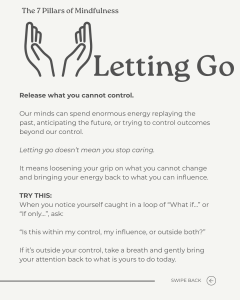
How Mindfulness Supports Life With Chronic Illness
Taken together, these seven pillars do something quite profound. They shift the way you relate to your experience. Less resistance, more presence. Less self-criticism, more self-awareness. Less reactivity at the doctor’s office, more grounded, confident advocacy for your own care.
That matters. Research consistently links mindfulness practice to reduced stress, improved emotional regulation, and better quality of life in people managing chronic health conditions. But knowing about mindfulness and actually integrating it—especially when you’re exhausted, overwhelmed, or navigating a difficult diagnosis—are two very different things.
That’s where working with a patient advocate and health and wellness coach can make a real difference. Together, you can explore which of these pillars is hardest for you, identify where your patterns of judgment or striving are creating unnecessary suffering, and build a more confident, centered approach to managing your health—in appointments and in everyday life.
A Different Way to Meet the Life You’re Living
Mindfulness isn’t about doing life perfectly. It’s about learning to show up – to your symptoms, your appointments, your emotions, and your body – with more curiosity, more compassion, and a little less pressure to have it all figured out.
Which pillar do you need most right now?
If you’re navigating chronic or complex illness and want support making healthcare feel more manageable, meaningful, and for your life to become more joyful, I’d love to connect. Schedule a FREE discovery session today—and let’s find a way forward that actually works for you.